
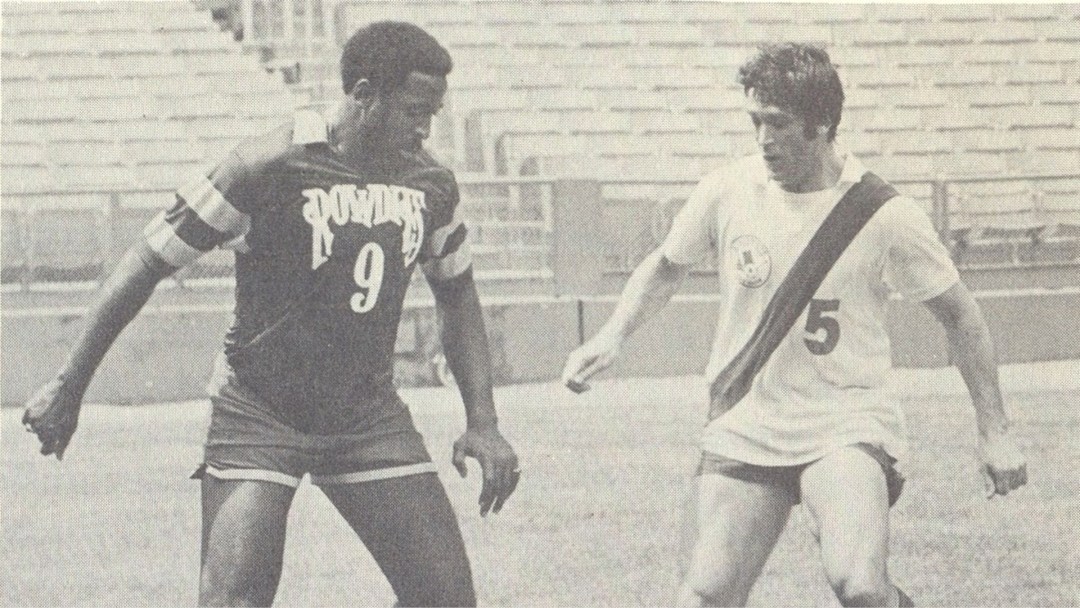
Clyde Best was not a household name in Tampa Bay when he joined the Rowdies for their inaugural season in 1975, but his new teammates were very familiar with the Bermudan striker from his time at West Ham United.
Many of them, like Farrukh Quraishi and Mark Lindsay, came from England as well. They had watched Best break new ground as one of the first black stars of the sport in England, earning his place at West Ham as a teenage trialist before going on to tally 58 goals in over 200 appearances for the club.
Quraishi and Lindsay discussed Best’s legacy in England and with the Rowdies ahead of the U.S. Premiere of Transforming the Beautiful Game: The Clyde Best Story, a new documentary chronicling Best’s career screening at The Palladium Theater in St. Petersburg May 7-9.
“Clyde had maturity and tenacity that was born of the fact that he had to prove himself not just as a player, but as a black player in England when there were almost no black players playing,” says Quraishi. “He started at 17 years old as well. That’s a very young age to have to carry that mantle. He had to mature very quickly. He not only matured and was able to do that, but he also produced results. He scored goals in a very good West Ham team.”
While Best and Quraishi were the same age, Lindsay was four years younger. He came to the Rowdies as the second youngest player on the roster that first season after starting his career at Crystal Palace, where he faced his own difficulties as the club’s only black player at the time. Both Lindsay and Clyde were on short-term loans to the Rowdies for the 1975. Following the team’s success that first year, both players requested permanent moves to Tampa Bay for 1976.
“Much like Clyde, I heard some really unpleasant things from the stands, and even from opposing players on the field,” says Lindsay. “I don’t think it was easy for any of us. West Ham got a lot of attention because they had three really good black players in Clyde, Ade Cocker, and Clive Charles. But the attitude in country was not very welcome for black players. I never understood it. If you looked outside of England, the sport was full of amazing players of color.”
A disturbing story shared in the new documentary details an anonymous letter Best received while at West Ham with a warning that acid would be thrown on him the next time he took the field. Best’s teammates, led by captain Bobby More, responded by shielding him as they took the field together.
Stories like that were the unfortunate reality black players faced. Among his collection of memorabilia from his career, Lindsay has kept news clippings from the period that question whethere black players even belonged in the game.
“It was hurtful,” says Lindsay. “I suppose I kept those clippings as a reminder. It’s a reminder of what we endured, and proof of how much things have changed. I was the only black player at Crystal Palace, and when I look at Crystal Palace today it’s almost all black players. It’s an issue we’re still not fully past. It’ll time come up today unfortunately, but there’s been progress for sure.”
Eventually, Best traded the pressure cooker of English football for a new venture with the Rowdies. Quraishi got to know Best well as his roommate during the club’s early days. In the evenings, the two would often go on runs together, with Best electing to wear a rubber diver’s wetsuit to shed a little bit of extra weight in the Tampa heat.
“Off the field he’s a sweet, cuddly guy. On the field he was a warrior,” says Quraishi. “He was a wonderful player on the field, but he was worth his weight in gold in the locker room for what he brought to the team and team spirit as well.”
Best and his Rowdies teammates had a bonding experience during their first trip down to Miami in June of the inaugural season. Lindsay came to the aid of a teammate who had been agressively fouled, leading to retaliation from Miami, and then eventually a bench-clearing brawl. Best was right in the thick of the action.
“Clyde always fancied himself a boxer,” jokes Quraishi. “He was bouncing around on his toes like a boxer fighting players. He wasn’t allowing anyone to get behind him. It’s things like that endeared him to us. He so easily could have walked away from it and said I’m not getting involved. But he wasn’t going to see Mark Lindsay beaten up.”
While Derek Smethurst led the Rowdies in scoring in 1975, Best’s contributions on the field were equally valuable.
“The thing that set Clyde apart from most others was his speed,” says Lindsay. “He was obviously big and tall, and he could stand up to the physicality of the game back then with the best of them. But quick bursts of pace would catch defenders by surprise. They’d be expecting to go in for a crunching tackle and before they knew what happened, Clyde was behind them and the ball was in the back of the net.”
Best’s game-changing pace was on full display in the 1975 NASL Soccer Bowl Final against the Portland Timbers. With a narrow 1-0 lead in hand, Best sealed the result for the Rowdies in the 88th minute with a blistering run down the field before slipping a shot past the keeper to secure Tampa Bay’s first-ever championship title.
Tickets and more information on Transforming the Beautiful Game: The Clyde Best Story are available at ClydeBest.com


















-1.png)